|
 |
|
 |
Store-Kyoto.com |
History of Artistic Textiles
The Japanese people, with their excellent artistic talent, have formed an original culture not only by developing indigenous cultural elements, but by deftly assimilating many foreign cultural elements, originating both in the West and the East, which streamed into their country in different ages. The techniques of dyeing and weaving also made great progress in Japan in the Nara era (710-784) under the influence of Chinese culture in the Sui and T'ang periods, during which China expanded into a world power. Thus, Japanese textiles reached a high artistic standard in this era, during which Buddhism was also introduced to Japan.
After the designation of Kyoto as Japan's new capital, craftsmen specializing in dying and weaving settled in the Nishijin district of the city to serve the Emperor's court. They formed a well-organized community led by members of the House of Hata, who possessed the then unrivaled expertise in this field. The community gradually expanded by absorbing commercial textile manufacturers, making Nishijin the center of textile industry in Japan.
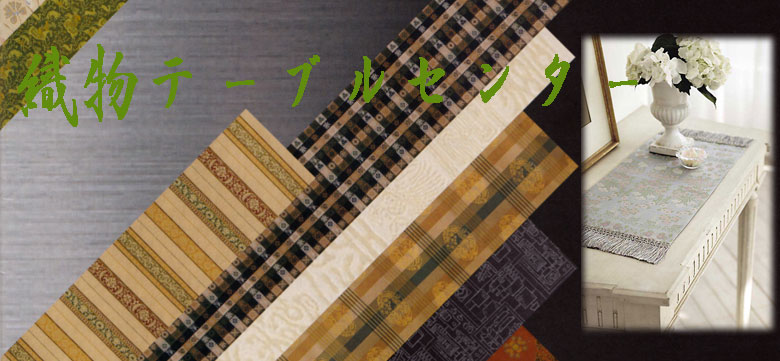
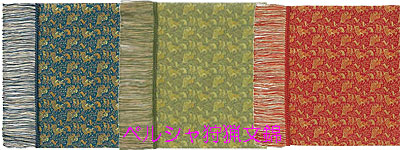
This table center piece made from "History of Artistic Textiles".
It is an elegant commodity very pleased as the gift of the happy event such as congratulation and commemorative gifts of building.
|
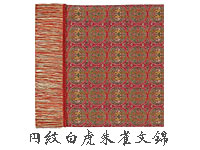 |
DAL-130(L)
Size : 42cm x 83 cm
Price : 22,000JPY
|
|
|
DAL-130(M)
Size : 32cm x 67 cm
Price : 12,000JPY |
|
Nishiki, With Roundels Enclosing Byakko And Shuzaku
The pattern showing tendril roundels enclosing mandarin ducks often appears in cloths produced in China during the "Six Dynasty" era. Since ancient times,
mandarin ducks have been the symbol of love and harmony between husband and
wife.
The mandarin duck pattern is used in various forms for treasures housed in the Shoso-in Repository in Japan. Among these treasures, this nishiki is noteworthy due to the gorgeousness and nobleness of its pattern. |
|
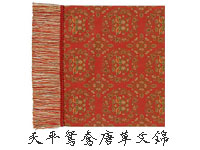 |
DAL-121(L)
Size : 42cm x 87 cm
Price : 22,000JPY
|
|
|
DAL-121(M)
Size : 32cm x 65 cm
Price : 12,000JPY |
|
Nishiki in the Tenpyo Period,with Tendril Roundels Enclosing Mandarin
Ducks
The pattern showing tendril roundels enclosing mandarin ducks often appears in
cloths produced in China during the "Six Dynasty" era. Since ancient times,
mandarin ducks have been the symbol of love and harmony between husband and
wife.
The mandarin duck pattern is used in various forms for treasures housed in the
Shoso-in Repository in Japan. Among these treasures, this nishiki is noteworthy
due to the gorgeousness and nobleness of its pattern.
|
|